This article was originally published on Substack.
In Antinet Zettelkasten, Scott P. Scheper describes two processes for using zettelkasten as a knowledge-development system. The first develops thinking through writing ideas down. As Prof. Pierluigi Piazzi said, there is no study without writing. Niklas Luhmann wrote in his zettelkasten:
“Nobody can think without writing; at least not in a sophisticated, connectable way.”
— Source
The second process uses zettelkasten as a communication partner—described as long-term knowledge development.
The first process is short-term knowledge development. An interesting point is the word “development.” Many people discover zettelkasten through PKM (personal knowledge management). Using “development” instead of “management” reflects the idea that zettelkasten is not your “second brain” or a commonplace book. I discuss the goal of zettelkasten in Reasons to use Zettelkasten.
For me, zettelkasten clarified how to build and organize acquired knowledge. My pain point was merging notes from different sources into one system effectively, so I could learn at every stage without the whole thing turning into a mess I’d abandon.
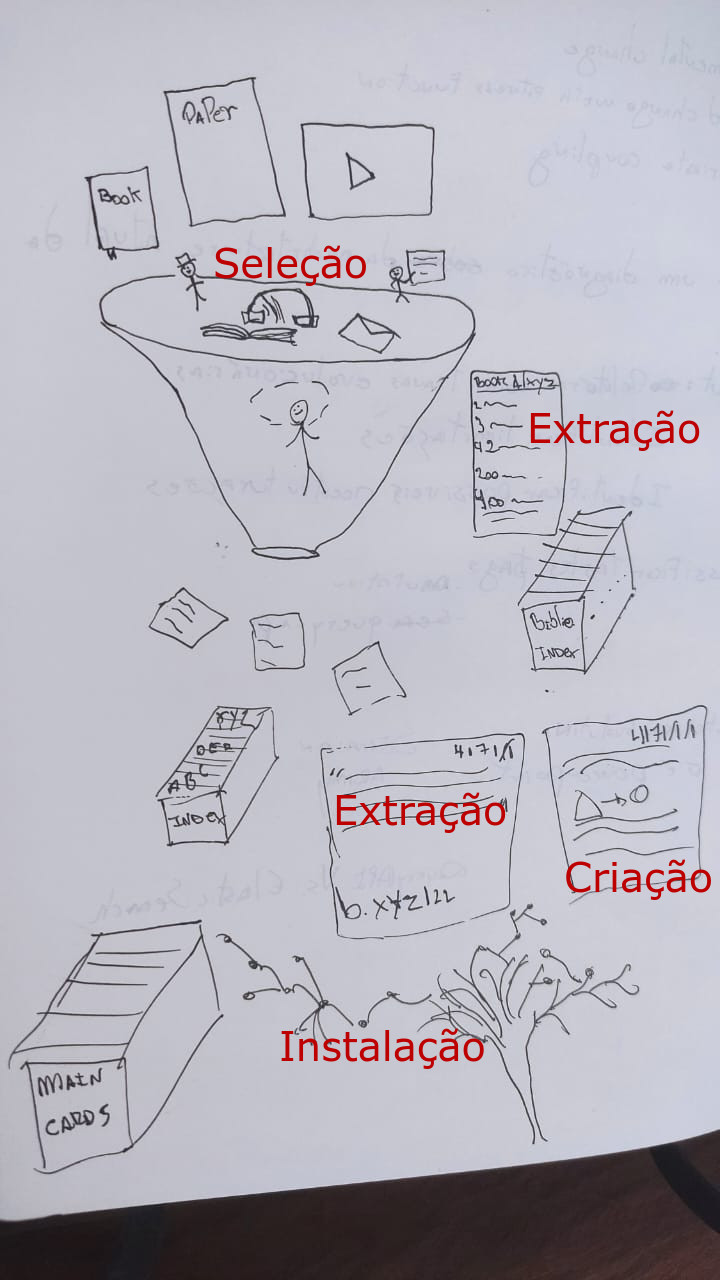
Below is a short summary of what Scheper describes: four phases inside the first process (developing thinking through writing): selection, extraction, creation, and installation.
Selection
Selection means deciding which ideas in what you’re consuming are worth engaging with. When you have a goal in mind, it’s clearer what to select. Reading Sapiens by Yuval Noah Harari, every paragraph has interesting ideas—imagine one card per idea. Having a purpose while reading clarifies what belongs in your Zettelkasten.
Here you practice picking relevant information and filtering noise: trusting sources, judging quality, and focusing on what matters.
Extraction
Next comes extraction. After selecting, you highlight the material—marginalia in the book, notes on a bibliographic card, or a new card with a summary, quote, or paraphrase.
You practice turning important information into a storable, retrievable form based on the relevance you assign in the moment—including synthesis and spotting key concepts.
Creation
Reflections and new ideas emerge through dialogue with your zettelkasten and relationships among notes. Connections appear; this is often the most rewarding phase because knowledge actually develops. You can capture all of it on cards for the box.
You practice generating new ideas and linking existing information in novel ways—creativity and connecting distant concepts.
Installation
After creating cards, you address them inside the zettelkasten. It’s easy to get stuck spending too long choosing the “perfect” location. Feeding the index happens here too.
You practice integrating information into an existing structure and linking it to other relevant material—organization, categorization, and connection-building.
In short, zettelkasten supports knowledge development in both the short and long term. By writing, selecting, extracting, creating, and installing notes, you build a solid, coherent structure that helps you assimilate and connect ideas. I hope you enjoyed it—comments welcome, and see you next time.